
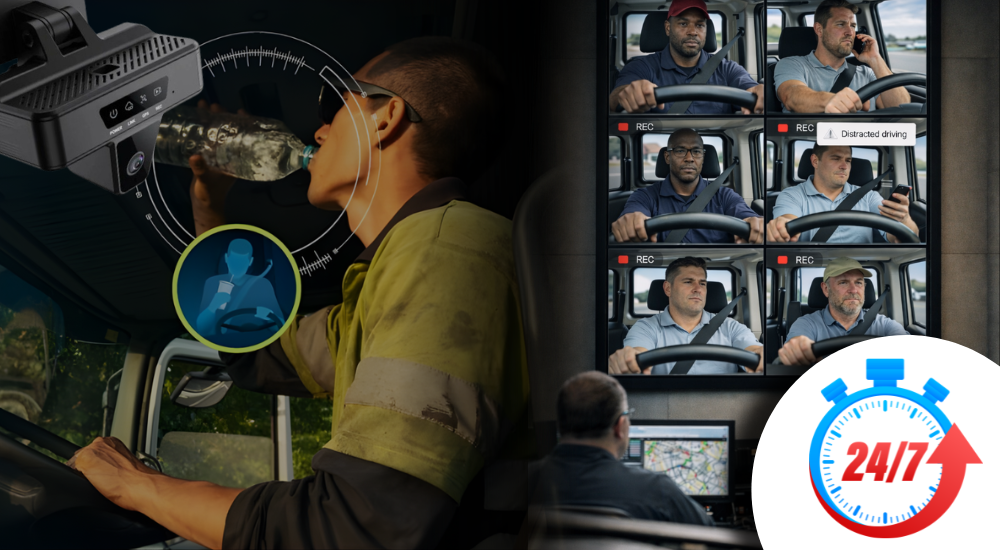
Fleet managers have never had more data at their fingertips. Yet many organisations still rely on a narrow set of indicators, most commonly GPS tracking, basic telematics, and incident reports that arrive after the fact. Tracking is useful, but it is not the same as safety. Knowing where a vehicle is does not tell you what the driver is doing, what risks are building, or how quickly your operation can respond when behaviour shifts from normal to dangerous.
That is why AI enabled in vehicle cameras have become an essential part of modern fleet safety. They bring visibility into the driver environment and provide objective evidence of what is happening on the road. When those cameras are bundled with a 24 hour control room, the value multiplies. The fleet is not simply recorded. It is actively monitored 24 seven, with risks detected, verified, escalated, and used to improve driver performance over time.
For organisations operating in South Africa, where long distance travel, uneven road conditions, operational pressure, and duty of care obligations are constant realities, this combination offers a practical pathway to risk reduction that goes far beyond tracking.
Why Tracking Alone Falls Short
GPS tracking provides location, route history, and utilisation. In many cases it can also indicate speeding or harsh events. The problem is that location data rarely provides context.
A telematics alert may show harsh braking, but not whether the driver was following too closely, distracted, or reacting to an unavoidable hazard. A speeding alert may show velocity, but not whether the driver was overtaking dangerously, driving into a high risk zone, or responding to time pressure. And when alerts are reviewed hours or days later, opportunities for prevention are already lost.
Real safety improvement requires three things that tracking alone cannot deliver:
Clear evidence of driver behaviour
Immediate escalation when risk occurs
Data that can be used to coach and improve performance
This is where AI cameras and 24 hour monitoring play a critical role.
The Role of AI Cameras in Fleet Safety
AI cameras are not just dashcams. They do not only record footage for later use. They interpret behaviour, detect risk events, and produce structured data that fleet managers can use for performance management and prevention.
Depending on the system configuration, AI enabled cameras can detect indicators such as:
Driver distraction, including mobile phone use
Seatbelt compliance
Tailgating and unsafe following distance
Harsh braking and harsh acceleration with visual context
Signs of fatigue or inattention
Near misses and high risk driving events
Cabin behaviour that increases risk
This matters because unsafe driving behaviour is often repetitive. A single risky event may be a one off. A pattern of risky events is a leading indicator of an incident waiting to happen. AI cameras make patterns visible and measurable.
They also provide fairness. When coaching or disciplinary action is required, decisions are based on objective evidence, not assumptions or hearsay.
Why Bundling Cameras With a 24 Hour Control Room Creates 24 Seven Monitoring
Cameras and AI provide detection. The control room provides action.
Even the most advanced safety technology loses value if there is no consistent human oversight. Alerts can be missed. Risk events can be ignored. Reports can become noise rather than guidance. A 24 hour control room changes the model entirely because it transforms monitoring from a dashboard into a live operational function.
When AI cameras are bundled with a 24 hour control room:
Risk events are detected and assessed immediately
Escalations happen while the journey is still in progress
Driver support can be initiated in real time
Management receives verified, prioritised reporting
Incident evidence is organised consistently and credibly
This closes the gap between detection and intervention, which is where many fleets fail. Safety is not improved by collecting data. It is improved by acting on data quickly and consistently.
The HSP Mobility Solutions Difference: Independent, Non Biased Reporting
A major challenge in fleet management is trust in reporting. When incident reviews are conducted internally, there is often perceived bias. Drivers may feel unfairly targeted. Managers may feel pressured to protect productivity at the expense of safety. Important details can be missed, minimised, or interpreted inconsistently.
At HSP Mobility Solutions, the control room is independent and designed to provide non biased reporting. This independence supports objective, evidence based assessment of risk events and driver behaviour trends.
Non biased reporting matters because it:
Improves trust between drivers and management
Creates consistent standards for safety evaluation
Strengthens incident investigation outcomes
Provides credible documentation for compliance and insurance purposes
Reduces internal conflict by grounding decisions in verified evidence
When accountability is built on fairness, it supports a stronger safety culture. Drivers become more willing to engage with coaching when they believe the system is objective and consistent.
How Data Insights Improve Driver Training
One of the most valuable outcomes of AI camera and control room integration is the quality of insights available for driver training.
Traditional driver training is often generic. It may cover rules, policies, and broad safety principles. But generic training rarely changes behaviour long term because it does not connect directly to real driving habits or real operational challenges.
Data led coaching is different. It allows training to be built around evidence from actual journeys, actual routes, and actual moments of risk.
With AI camera insights, driver training becomes:
Targeted, focusing on specific behaviours such as distraction, tailgating, or harsh braking
Relevant, because coaching uses real examples from daily operations
Measurable, because improvement can be tracked over time
Supportive, because patterns are addressed early before serious incidents occur
Fair, because feedback is grounded in consistent evidence rather than opinion
This approach also helps safety managers identify operational drivers of risk. If multiple drivers show the same risky patterns on the same routes or schedules, the problem may not be the driver alone. It may be unrealistic time windows, route selection, or delivery expectations. Data reveals the difference.
The KPIs That Become Stronger With AI Cameras and 24 Hour Monitoring
The real value of AI cameras and control room support is that they strengthen the KPIs that actually reduce risk.
Driver risk scoring becomes more accurate because behaviours are verified
Response time becomes measurable because alerts are acted on in real time
Near misses become visible and trackable, not hidden in daily operations
Fatigue and distraction patterns can be addressed proactively
Coaching effectiveness can be measured through reduced repeat events and improved scores
When these KPIs improve, incident rates drop, downtime decreases, and the fleet becomes safer and more resilient.
Building a Safety Culture That Protects People and Performance
Fleet safety is often treated as a compliance obligation. In reality, it is a leadership commitment. When organisations invest in systems that monitor risk consistently, respond in real time, and support driver development, they send a clear message that safety and professionalism matter.
This is especially important in South Africa, where fleets face long hours, high pressure operations, and complex road conditions. A safety culture built on continuous monitoring and evidence based coaching protects drivers, protects assets, and protects the organisation’s reputation.
The combination of AI cameras and a 24 hour control room is not about surveillance. It is about prevention, support, and improvement.
Ready to Monitor Your Fleet 24 Seven With Independent Oversight?
If your fleet is still relying mainly on GPS tracking and after the fact incident reviews, it may be time to move to a system that actively reduces risk while improving driver performance.
HSP Mobility Solutions provides AI enabled in vehicle camera solutions bundled with an independent 24 hour control room. This delivers continuous 24 seven monitoring, non biased reporting, and actionable insights that strengthen driver training and reduce incidents.
Contact HSP Mobility Solutions to discuss how AI camera intelligence and real time control room oversight can improve safety outcomes across your fleet, protect your drivers, and support a more resilient mobility operation.